
Idioms About Death: How to Talk About Endings in Natural English
Death is part of natural life.
Humans die. Pets die. Trees and plants die. Even situations die, ideas die, trends die, and plans die. Just as everything begins, everything ends — and in English we often use idioms about death to talk about those endings.
That’s why learning idioms about death matters. Not because we want to be negative, but because it helps you speak naturally, clearly, and sensitively in real English.
If you want the big picture first (what idioms are and why they matter), read our main guide here: Understanding Idioms: The Key to Natural Speech. (internal link)
What “Idioms About Death” Really Means
When people hear the phrase idioms about death, they often think it only means literal death.
But in everyday English, “death” language is used in two ways:
- Literal death (a person or animal dies)
- Metaphorical death (a plan dies, an idea dies, a project dies)
So learning idioms about death helps you understand:
- Real conversations
- TV shows and news language
- Workplace English (projects, ideas, decisions)
Idioms About Death and Sensitivity
When someone has physically died, people usually use respectful, direct language.
That’s why many “funny” death idioms (like kick the bucket) are not used in serious situations. They can sound rude or shocking if the context is emotional.
Understanding idioms about death is also about knowing what not to say, and when.
A Useful Death Expression: “Dead on Arrival” (DOA)
“Dead on arrival” is a widely used phrase, often shortened to DOA. It means someone (or something) was already dead when arriving somewhere — especially a hospital. (Cambridge Dictionary)
You’ll hear dead on arrival / DOA in medical and emergency contexts (especially in TV shows).
But it’s also used figuratively in everyday English, for example:
“That proposal was dead on arrival.”
Meaning: the idea had no chance of success from the start.
This is one reason idioms about death matter — because the same phrase can be used in serious contexts and in business contexts.

Why Idioms About Death Matter at Work
In meetings and professional conversations, English speakers often avoid saying “this idea is terrible.” Instead, they soften it using death language:
- “That project is dead.”
- “The plan died months ago.”
- “It’s basically dead on arrival.”
These are not meant to be emotional. They are just common ways to say:
- It won’t work
- It won’t continue
- It’s finished before it started
Understanding idioms about death helps you read the real meaning quickly — and respond with confidence.
Be Clever: Learn the Right Idioms About Death
There are lots of idioms about death in English, but you don’t need to memorise hundreds.
A smarter approach is:
- Learn a small number
- Understand when they’re appropriate
- Practise them in context
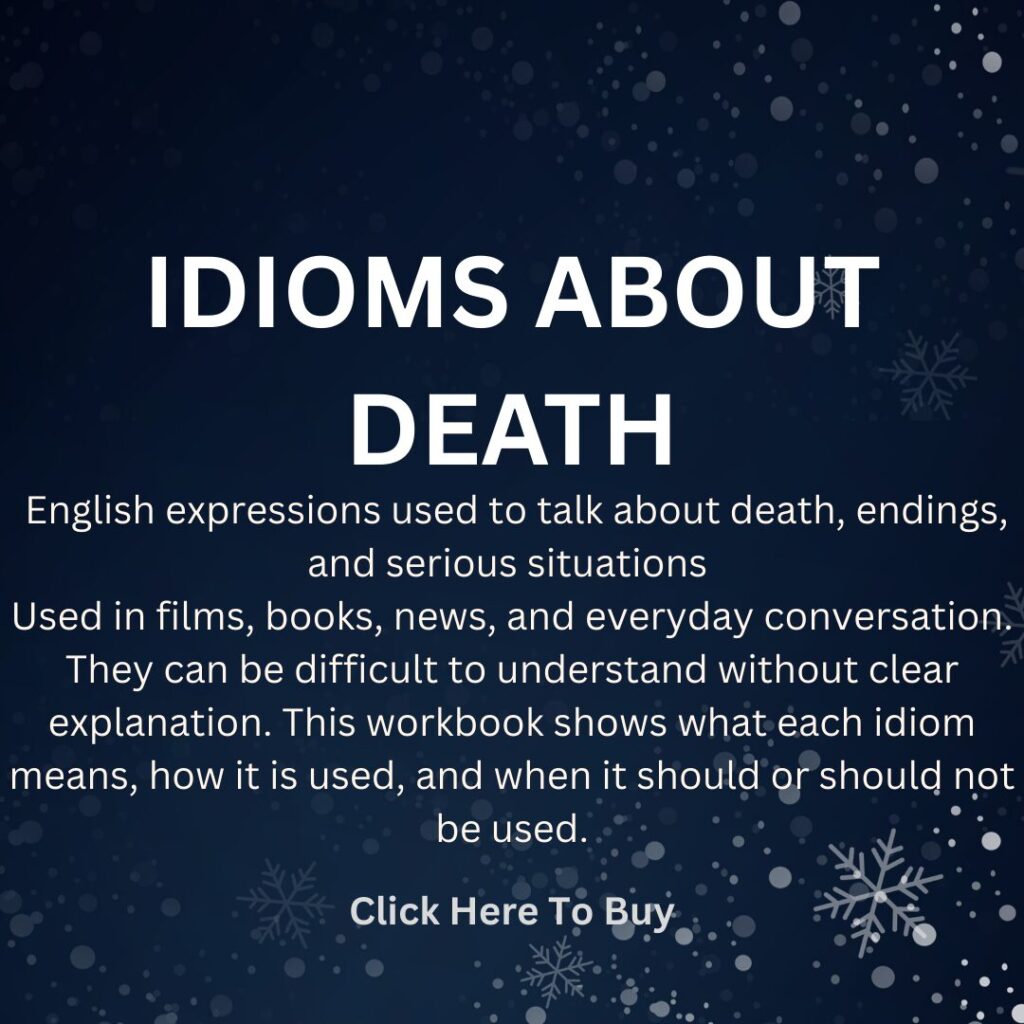
That’s exactly what our Idioms About Death resource is for.
👉 If you want more idioms about death, with clear explanations and real-life examples (including what’s appropriate and what to avoid), check out our book here: [link to your Idioms About Death book]
It’s designed to help you understand the idioms you’ll actually hear — without overwhelm.
Helpful References from Trusted Authorities
If you’d like extra support from well-known English-learning and dictionary sources, these are excellent:
- Cambridge Dictionary entry for dead on arrival / DOA (Cambridge Dictionary)
- Oxford Learner’s Dictionaries entry for DOA / dead on arrival (oxfordlearnersdictionaries.com)
Final Thought
Death is a natural part of life — and English reflects that.
Learning idioms about death helps you talk about endings with clarity, understand real conversations (including workplace English), and avoid awkward mistakes in sensitive moments.
Want more idioms?
Check out our posts on:
Stop guessing what idioms mean –start using them with confidence
These workbooks give you clear explanations, real examples, and simple exercises — so you can quickly learn idioms step by step.